ai · mcp · developers · 2026-07-01
MCP for advertising: connect agents to a buying seat, safely
How the Model Context Protocol lets AI agents use the same Waveband seat humans use, with spend ceilings, allowlists, and audit logs. Optional for teams that want it.
Most teams will run Waveband from the console. Some will wire agents. Waveband supports both: a full self-serve seat for operators, and an optional Model Context Protocol (MCP) server for teams that want software to act inside the same controls.
AI agents already write briefs, draft creative, and analyze reports. The missing piece is a safe way for them to act: to move budgets and launch campaigns under hard limits, instead of pasting instructions into a chat window for a human to execute.
What an agent can do
Waveband's MCP server exposes planning (draft a media plan from a brief), trafficking (create campaigns, line items, creatives), reporting (pull performance, explain deltas), and optimization (shift budgets, adjust bids) as tools.
The same service layer that powers the console and the REST API powers the MCP tools: no capability gap between human and agent operators.
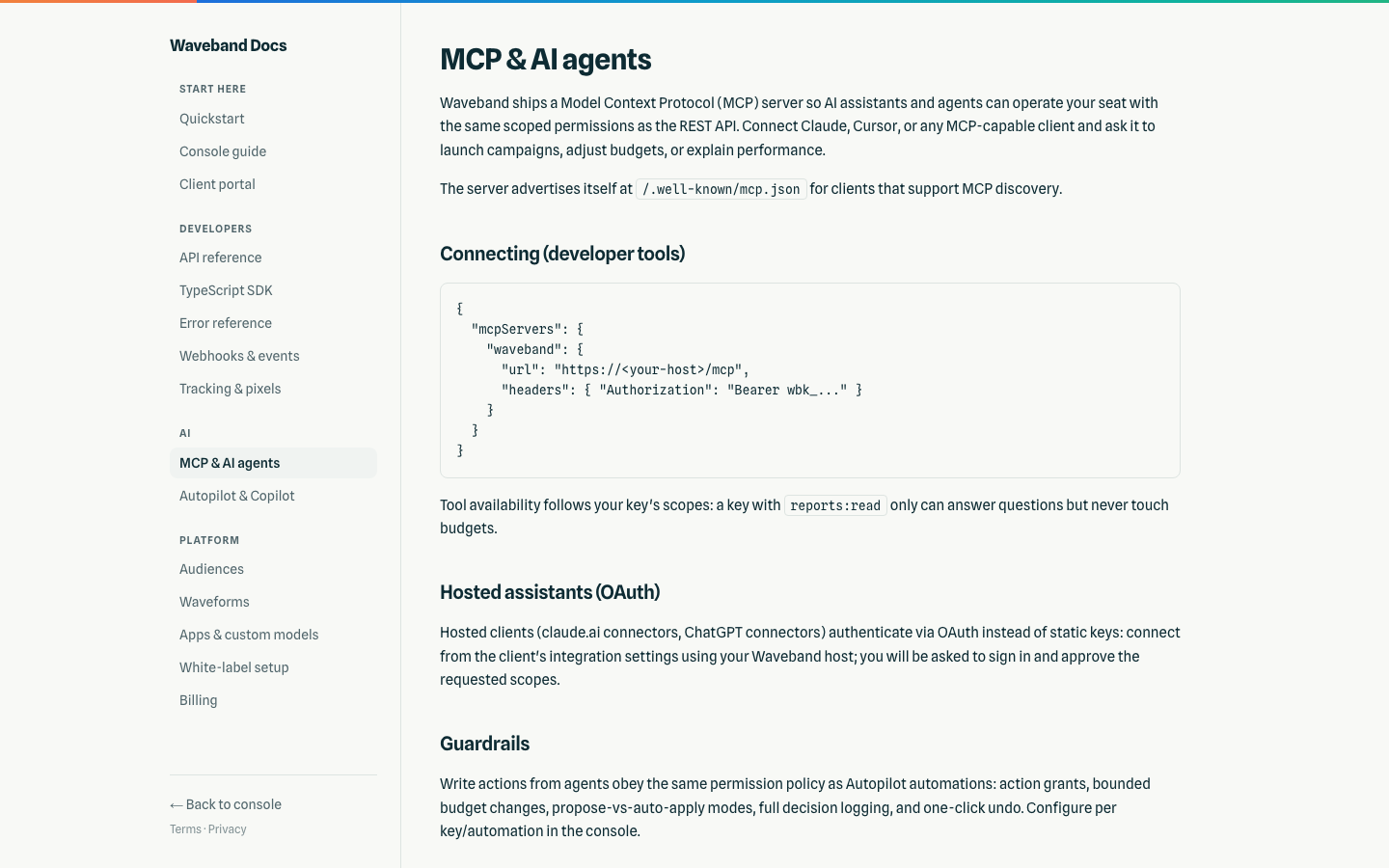
Connection and identity
Connection is standard OAuth 2.0 with PKCE and dynamic client registration: point any MCP client at the endpoint and authorize it like any other integration.
Agents are identities with policies, not anonymous chat sessions. That is how you revoke access, set ceilings, and read an audit trail that names who acted.
- Planning, trafficking, reporting, and optimization tools
- OAuth 2.0 with PKCE and dynamic client registration
- Per-agent spend ceilings and action allowlists
- Approval gates for destructive operations
- Audit log of every tool call with inputs and outputs
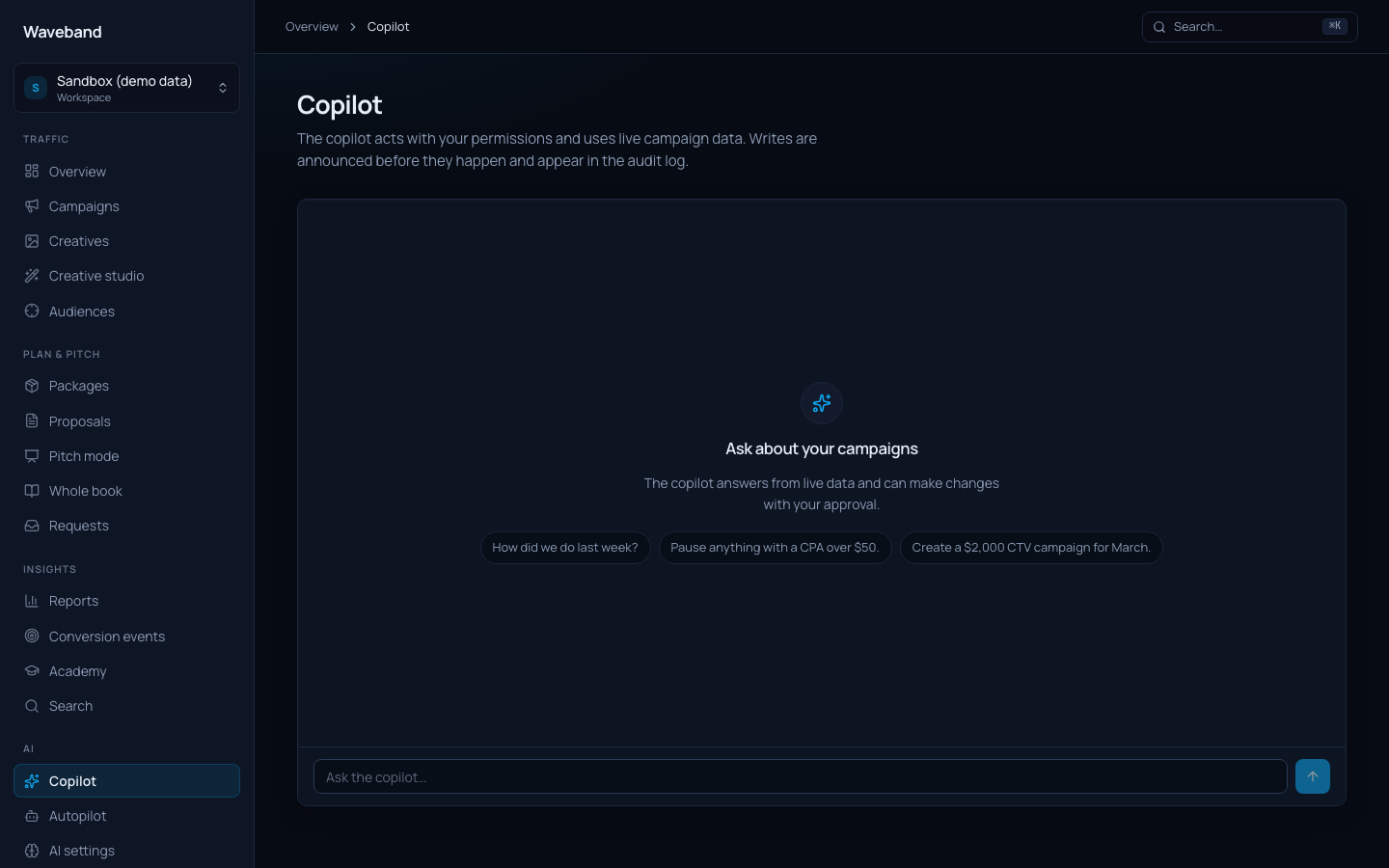
The safety model
Letting software spend money requires harder guarantees than letting it read reports. Agent permission policies set per-agent spend ceilings, action allowlists, and approval gates for destructive operations.
Every tool call is audit-logged with its inputs, outputs, and the identity of the calling agent. You pick the spectrum: read-only reporting agents, propose-and-approve planning agents, or (only if you choose) optimizers that act inside hard budget ceilings.
Optional by design
Nothing gets autonomous privileges by default. You can run Waveband for years without enabling MCP. Access to CTV, display, audio, Waveforms, Soundframe, and Signal does not depend on agents.
MCP is for teams that already have an agent workflow and need a buying seat that will not treat that workflow as a backdoor around operator controls.
How to adopt without drama
Start read-only. Pull reports. Then propose-and-approve for planning. Only later, if ever, allow bounded bid or budget actions. Keep ceilings lower than a junior trader's daily authority.
Pair MCP with the REST API docs so your engineers see one contract. Agents and humans should not get different truths about what the seat can do.